The GTM Operating Model Playbook for Value Creation
How to turn strategy into a commercial engine that compounds enterprise value
In SaaS and technology businesses, growth problems are often misdiagnosed.
Pipeline slows. CAC creeps up. Forecasting becomes unreliable. Expansion stalls.
The instinctive response is usually tactical:
Hire more SDRs
Launch new campaigns
Add more tools
Push for more activity
But in many cases, the real issue sits deeper. It’s the operating model behind the GTM engine.
How teams are structured.
How decisions are made.
How customer ownership works.
How data flows across the organisation.
When that operating model drifts, performance eventually follows, and for PE-backed and VC-backed companies, that drift shows up quickly in the metrics that matter most:
Net Revenue Retention
CAC payback
Forecast accuracy
Gross margin
Revenue per employee
These are the signals investors use to judge the durability of growth, not just top-line momentum.
Which is why getting the GTM operating model right is one of the most powerful levers for value creation.
The GTM Operating Model Value Creation Framework
Before diving into the playbook, it helps to think about the operating model as a structured system.
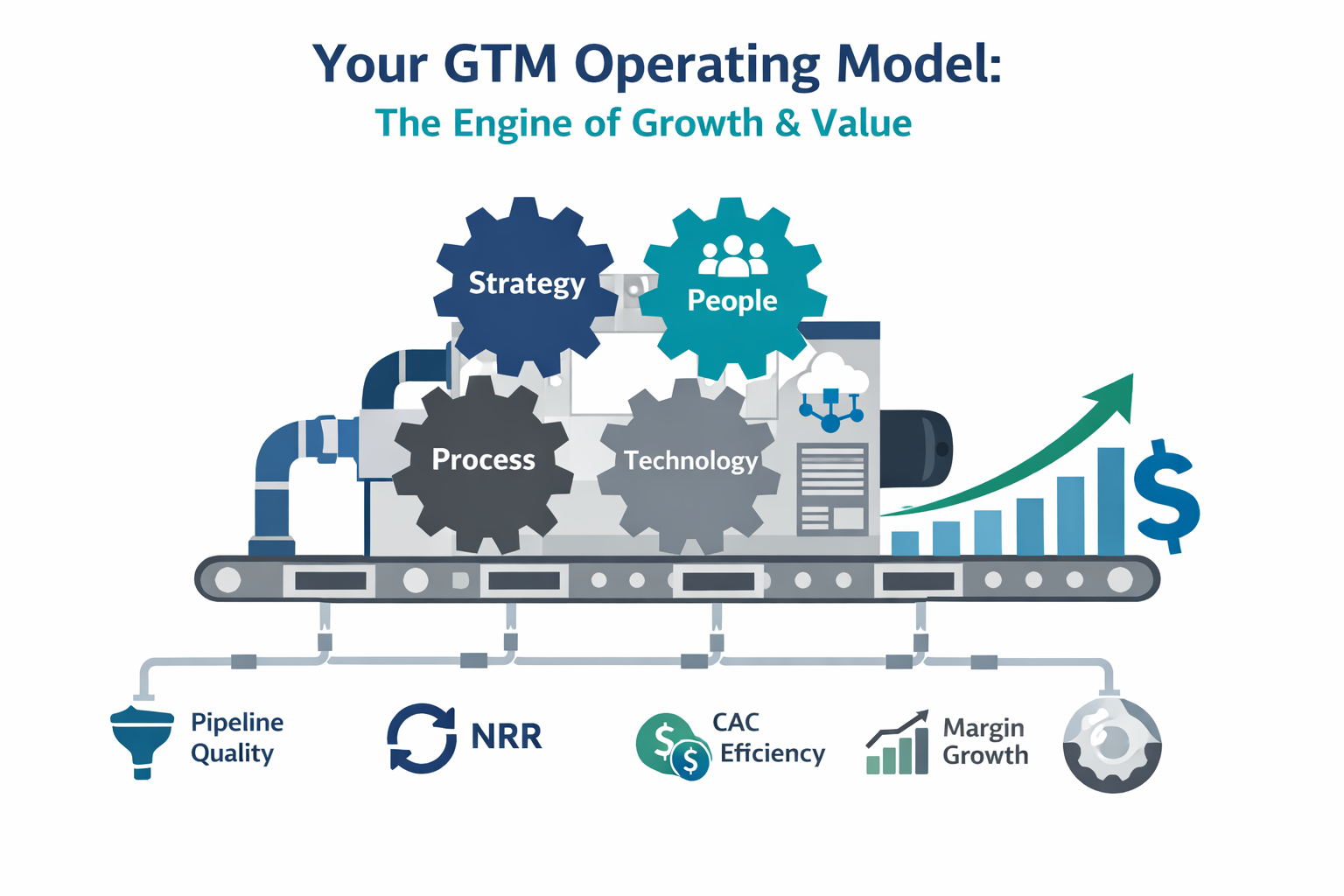
At a high level, a strong GTM engine aligns five things:
1️⃣ Customer - Who the business is built to serve.
2️⃣ Structure - How teams own the lifecycle.
3️⃣ Process - How work gets executed consistently.
4️⃣ Data - How decisions are made.
5️⃣ Technology & AI - How execution is accelerated.
When these elements are aligned, the commercial engine compounds.
When they’re not, organisations end up scaling friction.
The playbook below is a practical way to fix it
The GTM Operating Model Playbook
Step 1: Diagnose the GTM Engine
Before redesigning anything, understand how the business actually operates today.
Most companies skip this step and jump straight to solutions.
But the first task is to identify where value leakage occurs across the customer lifecycle.
Key areas to examine:
Customer segmentation
Which segments retain and expand the best?
Where does churn concentrate?
Pipeline quality
Are win rates falling?
Is pipeline coverage increasing, but conversion declining?
Post-sales performance
How long does it take customers to realise value?
What percentage of revenue comes from expansion?
Economic signals
CAC payback trends
Gross margin by segment
Expansion vs new logo mix
The goal is simple. Identify where economic performance breaks down.
Because operating model design should always follow economic reality.
Step 2: Re-Anchor the Business Around ICP
Most GTM problems start here.
Over time, the ICP discipline weakens, and sales teams chase revenue wherever they can find it. Additionally, Marketing expands targeting and Customer Success inherits customers that were never a good fit.
The result is predictable:
Lower win rates
Longer onboarding
Higher churn
Lower expansion
The strongest SaaS businesses maintain clear ICP discipline, built around customers who naturally succeed with the product.
When this is done properly:
Sales cycles shorten
Customer success improves
Expansion becomes structural
ICP optimisation is not just a marketing exercise. It’s a revenue quality exercise 🎯
Step 3: Align the GTM Structure to the Customer Lifecycle
Many organisations are structured around internal functions instead of customer outcomes.
The traditional model often looks like this:
Marketing → SDR → Sales → Implementation → Customer Success → Account Management
Every transition introduces friction, information gets lost, and accountability becomes blurred.
A stronger model aligns ownership around the customer lifecycle.
For example:
Commercial Ownership
Sales or Account Executive - Owns the new business commercial relationship.
Customer Value Ownership
Customer Success - Focuses on adoption, outcomes, value exapansion and retention.
Technical Ownership
Solutions / Product / Delivery - Supports onboarding and implementation.
This structure reduces friction, improves accountability, and creates a more consistent customer experience.
Step 4: Standardise the Core Revenue Processes
Execution consistency is what separates high-performing GTM teams from average ones.
That consistency comes from process maturity.
Key processes that should be standardised:
Qualification - Consistent methodology for identifying the right opportunities.
Onboarding - Clear milestones to deliver time-to-value.
Adoption and value delivery - Defined customer success milestones.
Expansion triggers - Signals that identify growth opportunities.
Renewals - Structured renewal management driven by customer outcomes.
Standardisation creates predictability. Predictability creates trust from boards and investors 🎯
Step 5: Redesign the Metrics Around Customer Economics
Many organisations still measure activity rather than outcomes.
Typical dashboards track:
Calls made
Emails sent
Meetings booked
These metrics measure effort. They do not measure value creation.
High-performing organisations track metrics that directly link operations to financial performance:
Time to first value
Net revenue retention
Expansion revenue drivers
Segment profitability
Lifecycle conversion rates
These metrics tie commercial performance to enterprise value drivers.
Step 6: Align Data Into One Commercial Truth
Even well-designed operating models fail when data is fragmented.
A common scenario in SaaS businesses:
Sales forecasts one number.
Customer Success tracks another.
Finance reports a third.
This creates confusion, slows decisions, and reduces forecast credibility.
High-performing organisations operate from one commercial truth, where:
Customer data is consistent
Metrics are shared across functions
Decision-making is aligned
When data alignment improves, decision speed increases, and speed is often the difference between good and great execution.
Step 7: Layer AI and Automation on Top
AI and automation are powerful accelerators, but they should never be the starting point.
In many organisations, the pattern looks like this:
AI tools are introduced quickly.
Processes are inconsistent.
Data quality is poor.
Ownership is unclear.
The outcome is predictable. You simply scale inefficiency faster.
AI works best when it sits on top of a clear operating model with defined processes and clean data.
When those foundations are in place, AI and automation can unlock real leverage across the GTM engine.
Examples include:
Revenue intelligence - Improving pipeline prioritisation and forecast accuracy.
Customer health analytics - Identifying churn risks earlier.
Expansion signals - Detecting growth opportunities based on usage and adoption.
Workflow automation - Reducing manual work across CRM, onboarding and reporting.
But the key rule remains simple.
AI should improve economic performance, not just productivity.
The real question is, does it improve:
Revenue per employee
Retention and expansion
CAC payback
Forecast accuracy
If the answer isn’t clear, it’s probably a distraction, and the foundations are not in place to deliver the value
Step 8 — Continuously Optimise the Model
Operating models are not static.
Markets evolve.
Customers evolve.
Technology evolves.
Leading organisations revisit their GTM operating model regularly to ensure it remains aligned with strategy and market conditions. because value creation rarely comes from one transformation.
It comes from continuous optimisation of the commercial engine.
The Real Takeaway
Value creation in SaaS is rarely about a single lever. It’s about building a commercial engine that compounds over time.
When the GTM operating model is aligned:
Pipeline quality improves
Onboarding becomes smoother
Retention increases
Expansion becomes predictable
Which ultimately leads to:
Higher Net Revenue Retention
Stronger margins
More reliable growth
And those are the signals that drive enterprise value.
✅ Simple rule: You can’t scale what you haven’t structured properly.
The operating model determines how the business actually runs. Everything else is just activity.
If you want someone who’s actually delivered this inside PE/VC-backed SaaS companies, — let’s connect 🚀
